Why brick works so well
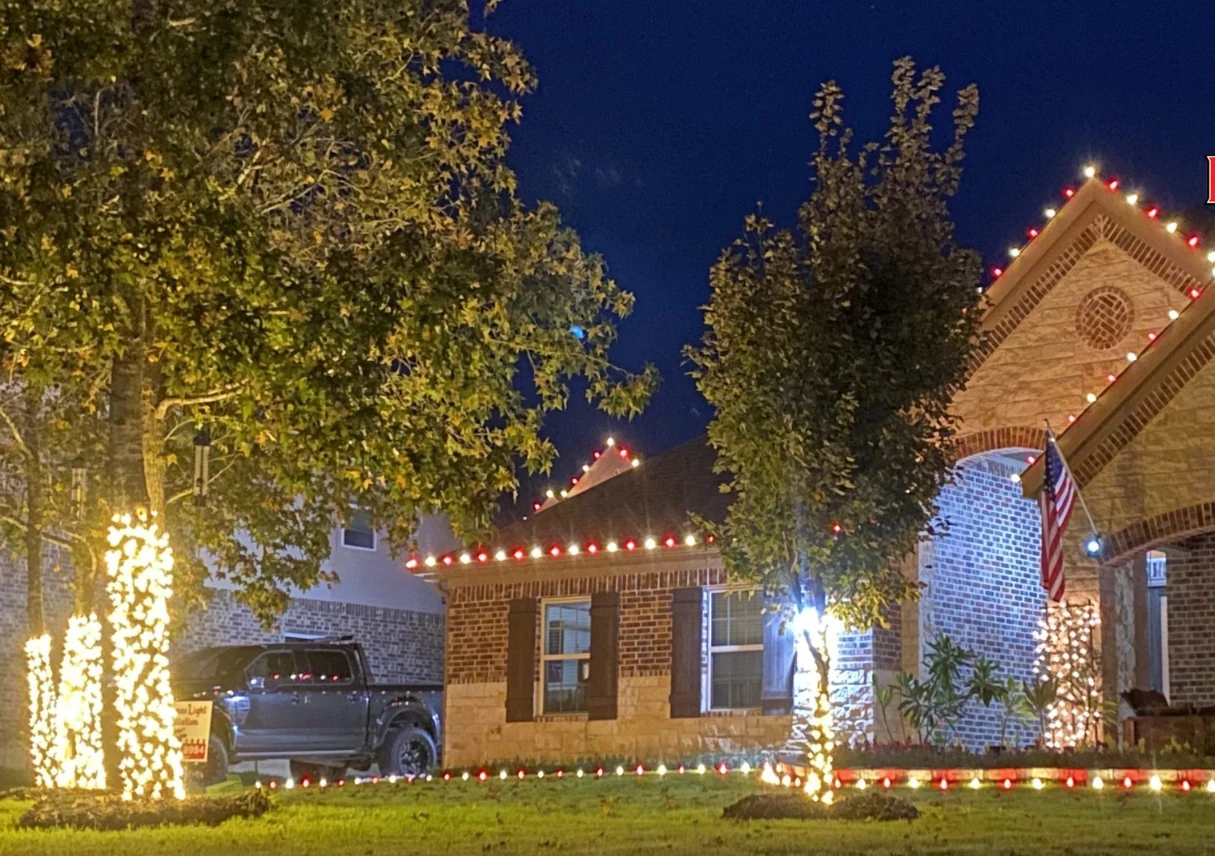
Brick is one of the most forgiving surfaces for holiday lighting. Its warm, textured face gives light something to play on, and its red and tan tones harmonize with warm white, red and green. Whereas a smooth painted wall can look flat under light, brick glows, which is why a well-lit brick home looks rich even with a simple design.
It also gives the house strong lines. The eaves, gables, chimney and window surrounds are all defined, and tracing them with light turns the architecture into a drawing. The challenge with a two-story is not what to light but how to reach it and how to keep the result in proportion.
Choosing colors for red and tan brick
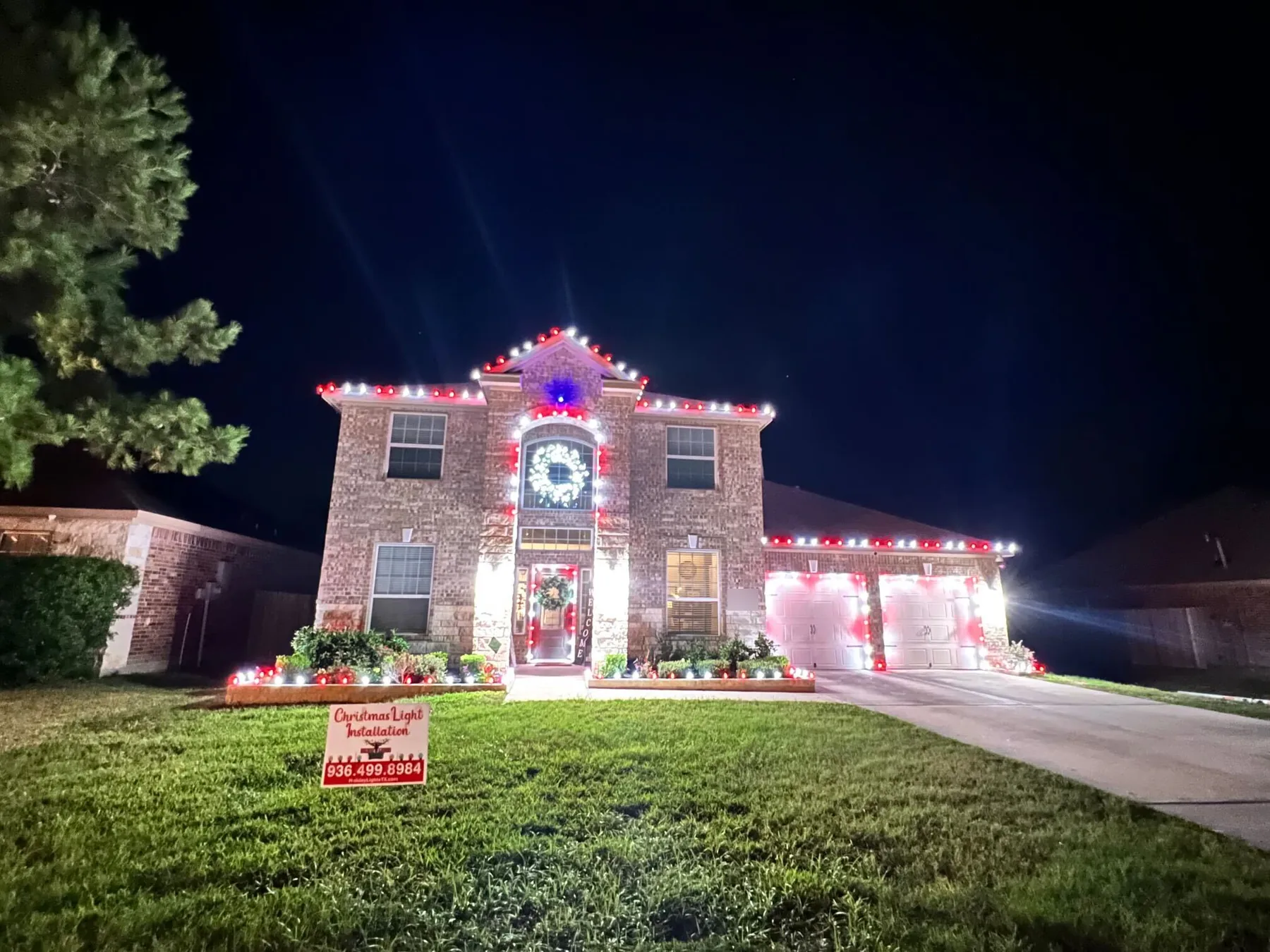
Warm white is the first choice. It lifts the color of the brick without competing with it, and it looks as good in a photograph as it does in person. If you want color, red and white is a natural fit, since red echoes the brick and white keeps it crisp. Red and green also works, with the green used sparingly.
Be careful with cool white and blue on red brick. The blue tone can make the brick look flat or slightly gray. If you love a cooler look, try it on a photo first with the see your home in lights tool. Our color scheme guide covers the options in more detail.
Treating the roofline in two levels
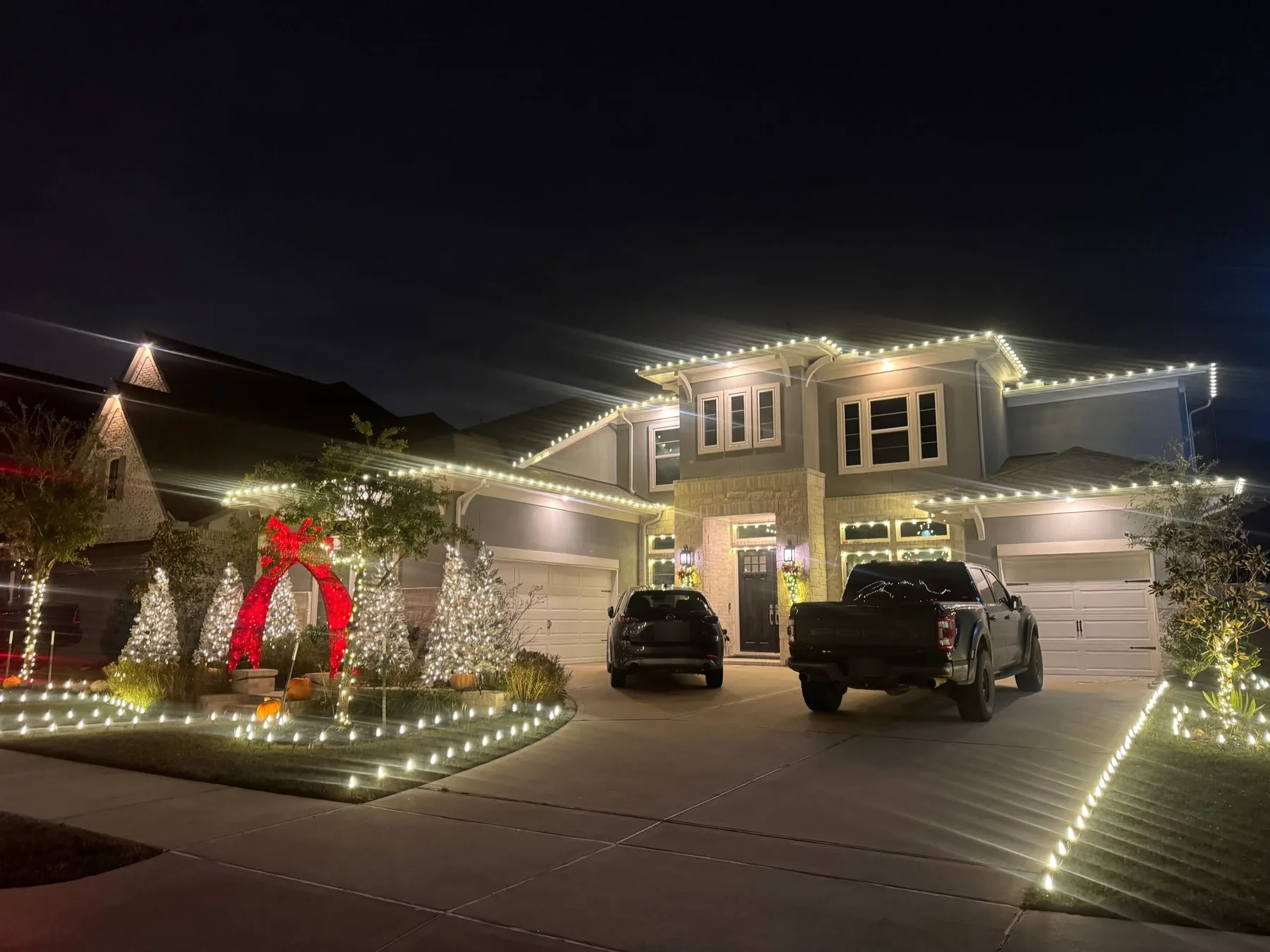
A two-story brick home usually has a first-level roofline over the garage and porch and a second-level eave and gables above. Lighting both gives the house depth. Lighting only the lower level leaves the upper floors dark, and lighting only the upper leaves the entry underlit.
The two levels are priced differently because they are installed at different heights: $6 per foot at the first level, $8 at the second and $10 at the third level or ridge. A typical two-story with all three often lands between $1,500 and $3,000 with some extras. See the cost guide for worked numbers.
Gables are the stars
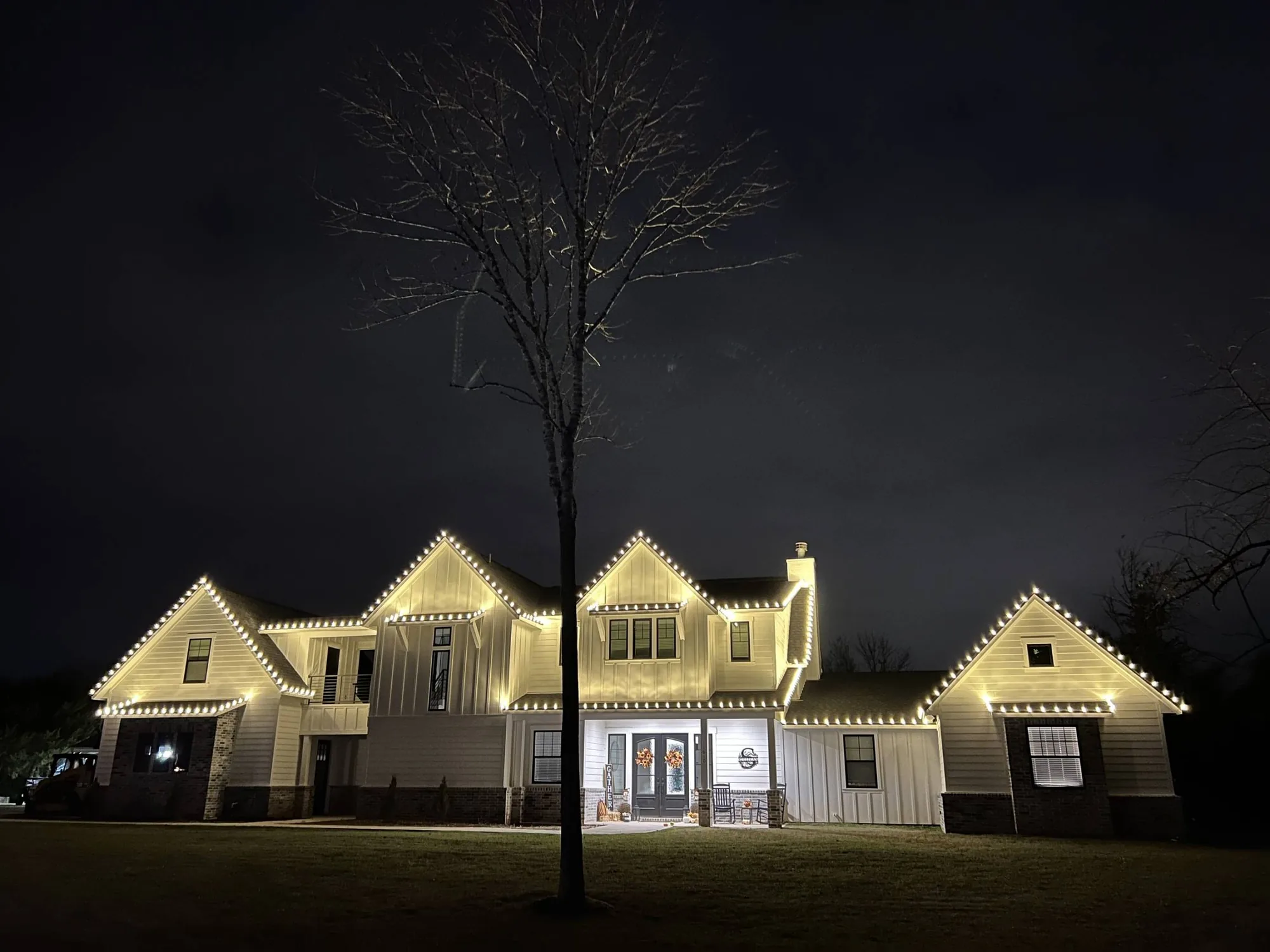
On a brick two-story, gables are the focal points. A steep front gable lit along both rakes forms a bright triangle that anchors the whole house, and a pair of gables gives symmetry. Lines should follow the edges cleanly and meet at the peak, which is exactly where custom cutting earns its keep.
If the house has a decorative element in the gable, such as a vent, a window or a medallion, consider whether to frame it with light. Often the cleaner choice is to light the edge and let the feature sit quietly within it.
Windows, doors and details
Window outlines add detail at close range, especially on the front elevation. Choose either all the windows or none on a given facade, because a few lit windows among many unlit ones look accidental. The front door is worth special attention, with a lit wreath or a garland frame, as we describe in the wreaths and garland guide.
Brick chimneys can be outlined or left alone. If the chimney is prominent from the street, lighting its edge connects it to the roofline. If it is on a side or rear wall, leave it.
Trees, beds and the approach
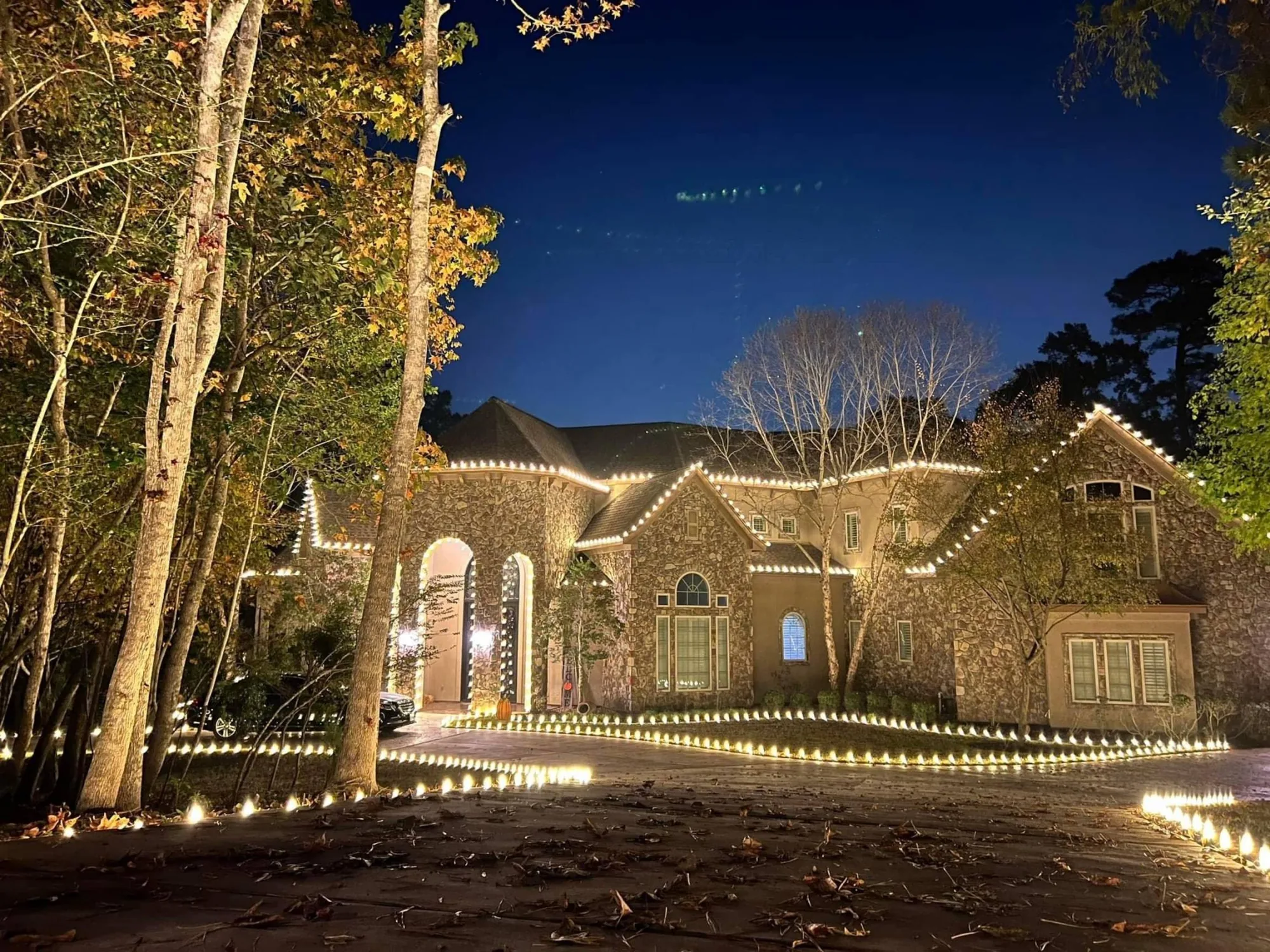
Brick homes often sit behind mature trees and foundation planting. Wrapping the trunks of the trees nearest the street adds height, while lit shrubs or a row of larger bulbs along the front bed grounds the house. Our gallery includes a Tudor-style brick home with red and green gables and a row of larger bulbs along the beds.
A walkway edge leads guests to the door and makes the entry feel like the end of a journey. See the tree wrapping guide for the options and the pricing by the strand.
A sample plan
Here is how a typical plan might look. Start with the full roofline at both levels, in warm white or red and white. Add the ridge cap if the roof is tall. Wrap two trees nearest the street. Frame the front door with garland and a wreath. Add a row of lights along the front bed or walkway. That sequence builds the display up in the order that gives the most effect.
If the budget is tight, stop after the roofline and the entry, and add the trees and walkway next season. Everything we install is stored and reinstalled, so the display can grow without being rebuilt.
Mistakes to avoid on a tall brick home
The first mistake is lighting only the lower roofline because it is easier to reach. A two-story with a lit first level and a dark second looks bottom-heavy and unfinished. If the budget does not allow every level, light the front gable and the main eave first and add the rest later.
The second is mixing too many colors on a house that already has strong texture. Brick is busy by nature, and a rainbow of lights on top of it can overwhelm the eye. One or two colors plus white keeps the picture clear.
The third is ignoring the sides. On a corner lot or a house that faces a through street, the side elevation is as visible as the front. Plan the lines to turn the corner cleanly.
Safety and access on a two-story
The second-story eave is where most DIY accidents happen. Ladders on uneven ground, a steep pitch and a long reach add up, and a fall from that height can be serious. Professional crews use the equipment that the property needs and are experienced at working at height.
This is not an argument that no one should ever hang their own lights, but it is a reason to count safety in your decision. The savings from doing it yourself do not look as large once the risk is on the scale. We cover the comparison in is professional installation worth it.
You do not need to be home when we install, and you do not need to do anything to prepare apart from keeping the area around the house accessible.
Lighting the neighborhood context
Brick two-stories often sit in subdivisions where the houses are similar. That can be an advantage: a well-designed display on a familiar house stands out for the quality of the line, not just the quantity of the lights. Clean corners, even spacing and a consistent white make a house look polished next to its neighbors.
It also means being aware of the street. If your neighbors have a particular style, you do not have to match it, but a display that harmonizes tends to be welcomed. If your community has rules, our HOA guide explains what to check.
Getting a price for your house
Every brick two-story is a little different, so the quickest route to a real number is to send us your address and a photo. We will estimate the footage at each level, confirm the details on site and give you a firm quote. You can also use the cost estimator to build a range yourself in a few minutes.
If you are comparing companies, ask each one to show footage by level and to say whether removal and storage are included. Our quotes always do, and they come back within 24 hours, usually the same business day.
Questions people ask
Warm white is the most reliable. Red and white and red and green also look good on red brick when used with restraint.
It depends on footage and extras. Rooflines are $6, $8 or $10 per foot depending on height, and a typical two-story with extras often falls between $1,500 and $3,000.
For most two-story homes, yes. Lighting both levels gives the house depth and avoids a dark upper half.
By the Holiday Lights Texas team, a family owned holiday lighting company based in Conroe, Texas. Published October 19, 2026, updated October 19, 2026. Every figure and policy referenced here is one the company publishes and honours on real properties. Where the company has not published a policy, this guide says so rather than guessing.
More in DesignAll resources