Start with what the street sees
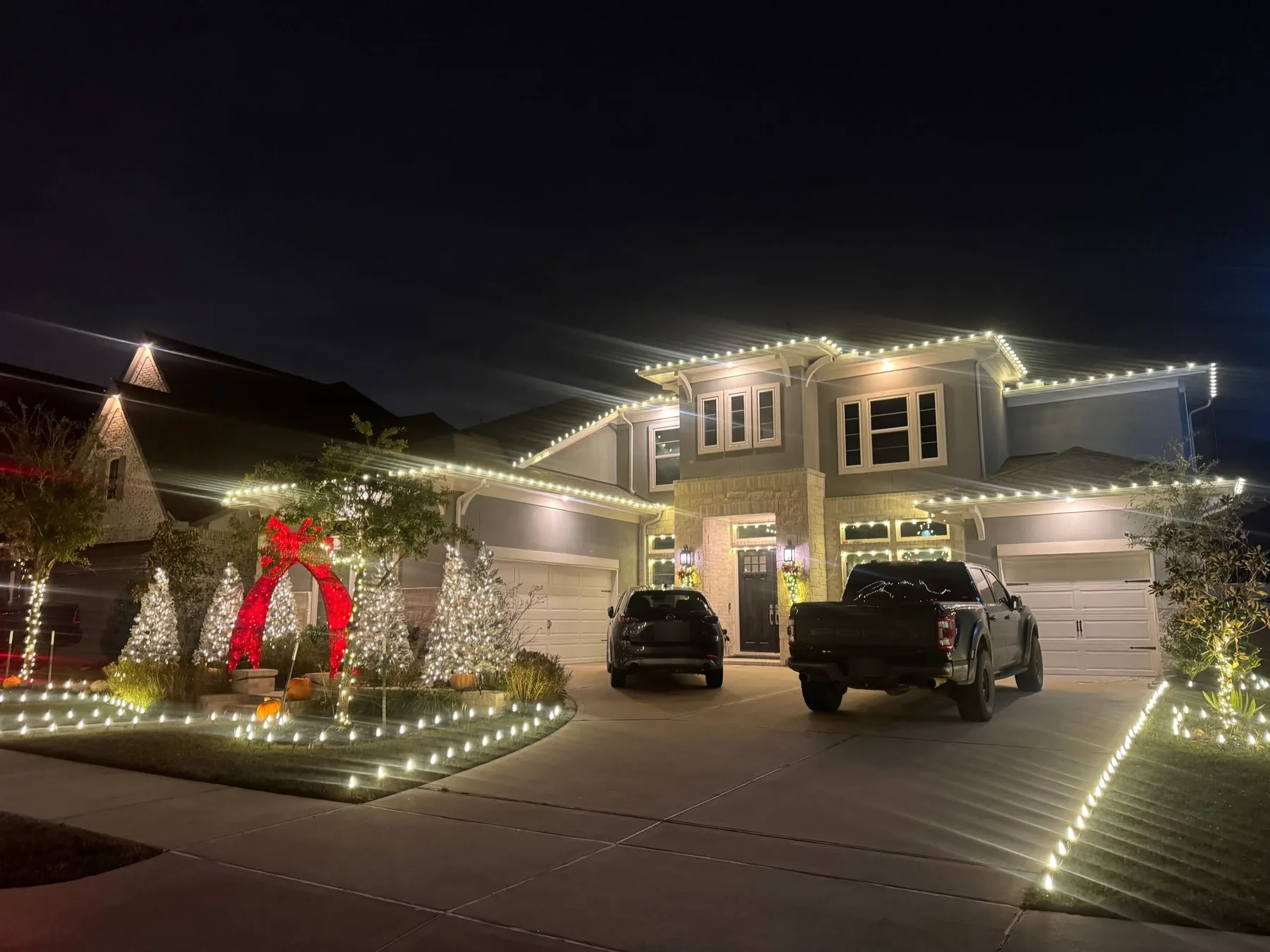
Most people see your house from the street at night, at a distance, in a few seconds. That tells you what to light first. The strongest single move is the front roofline, because it draws the outline of the house against the dark sky. Everything else builds on that line.
That is why our published packages start with a front roofline, from $799. For many homes it is the right first step, and for some it is the whole display.
The roofline package
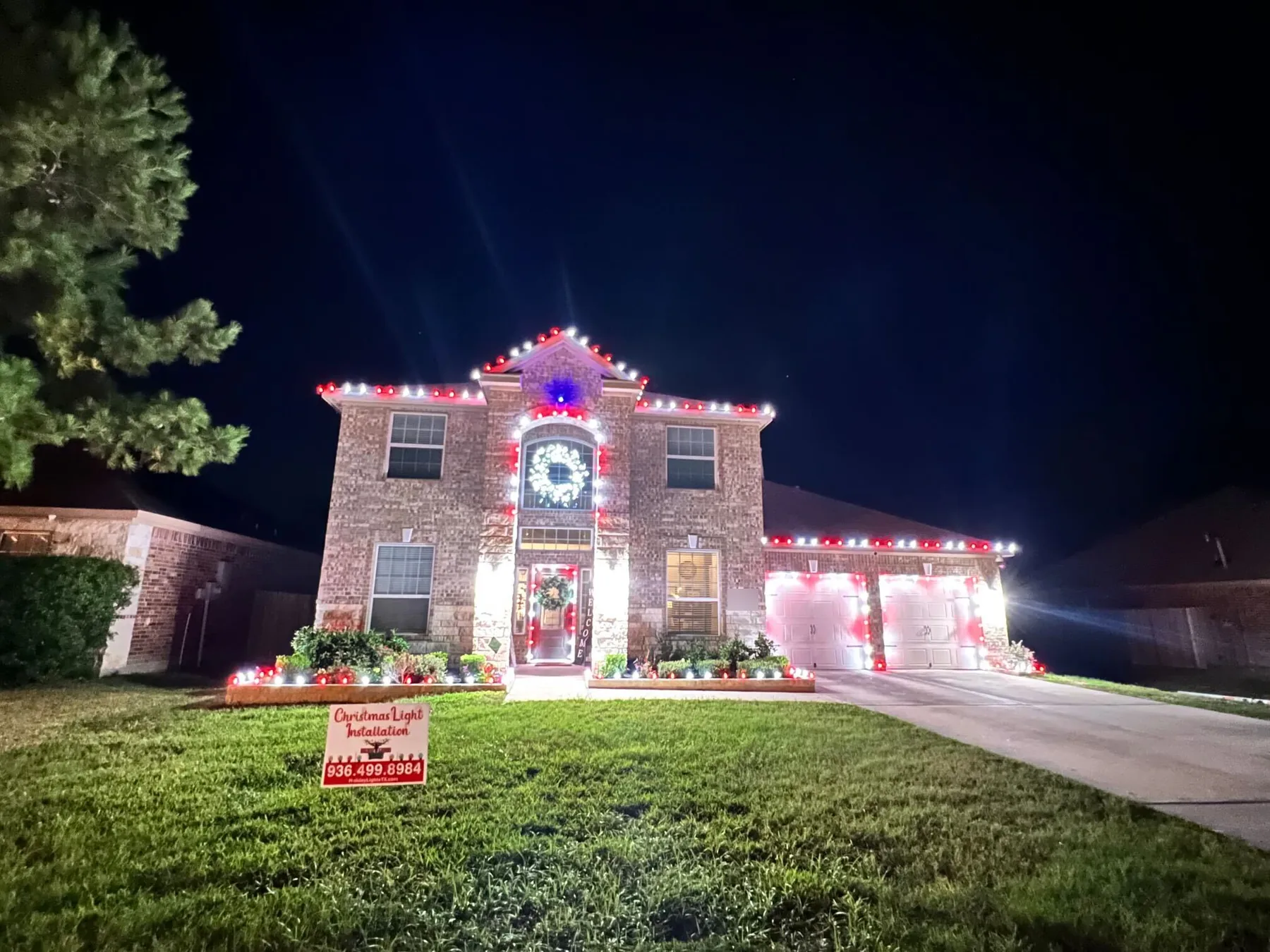
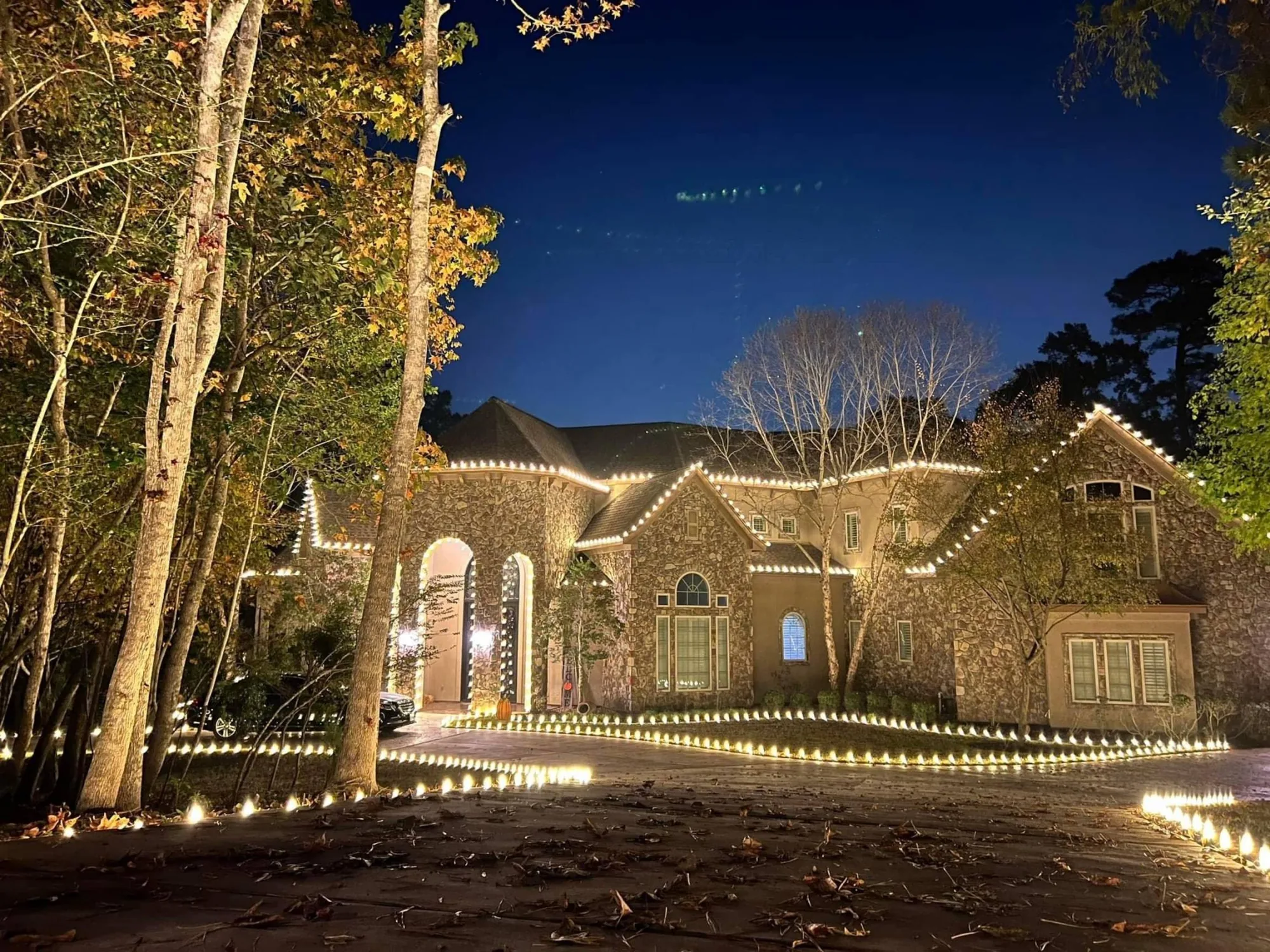
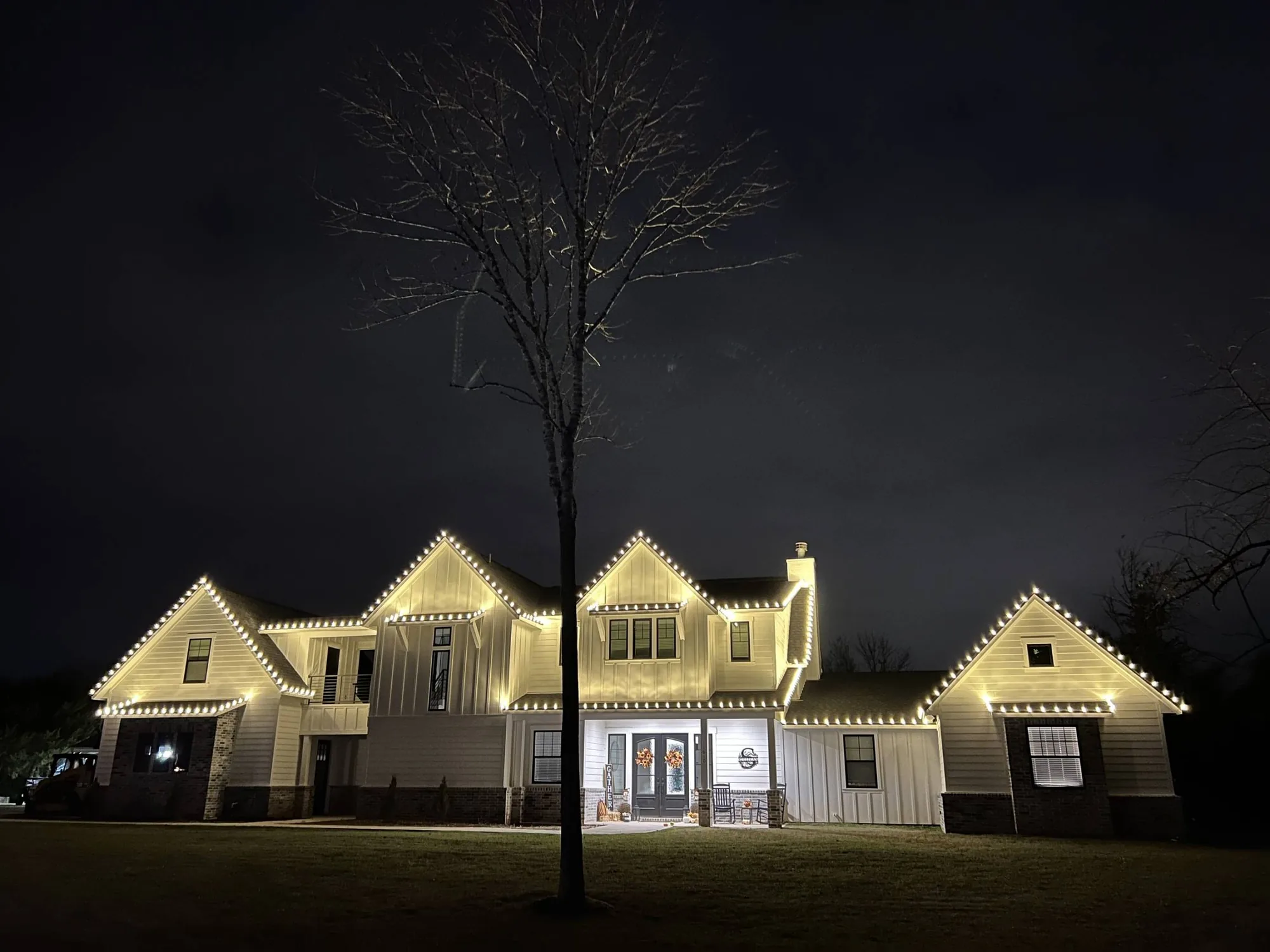
A roofline display outlines the main edges: eaves, gables, rakes and, if you add it, the ridge cap. It is clean, classic and easy to keep consistent from year to year. On a typical single-family home, roofline plus ridge cap usually falls between $800 and $1,500.
Roofline-only suits houses with strong architecture, tight budgets, or owners who like a restrained look. It is also the best foundation if you plan to add to the display later, because the line is already there and every addition will match it.
- Eaves, gables and rakes along the front
- Optional ridge cap to add height
- Garage and porch rooflines
- Entry door outline
What full property adds
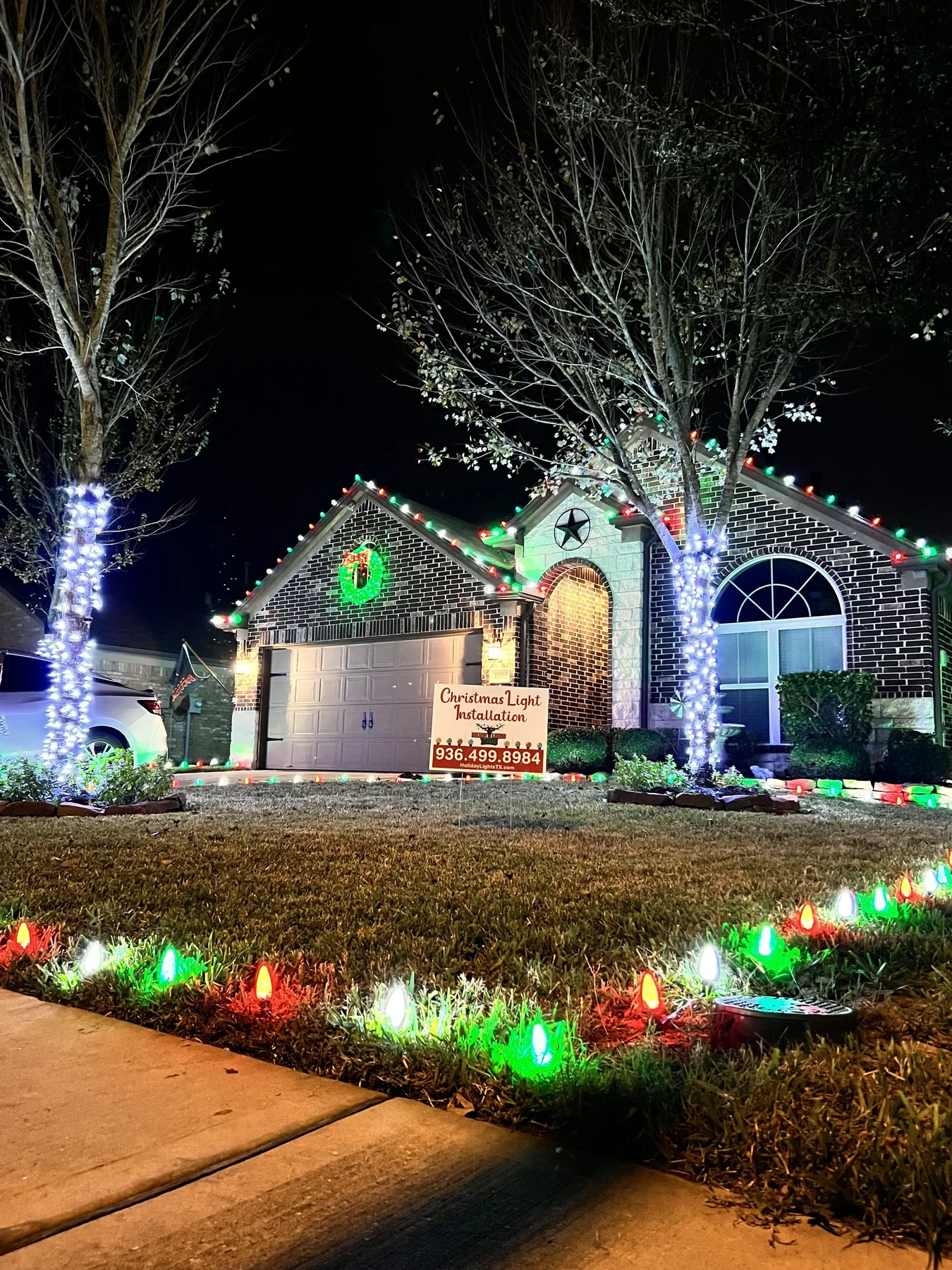
A full-property display extends beyond the roof. Wrapped tree trunks carry the eye upward. Lit hedges and beds ground the house. Walkway and driveway edges lead guests in, and a lit door or wreath gives the display a focal point. The effect is a composition rather than an outline.
Adding landscaping, tree wraps and walkways typically lands between $1,500 and $3,000, and full-property and multi-structure displays start at $3,000. Prices follow the feet and the strands, so you can add in steps. See the cost guide.
The order we usually recommend
If you are building up over several seasons, start with the front roofline, then the ridge cap if the roof is tall, then the trees nearest the street, then the walkway and beds. Each step increases the effect without redoing the last one, because the set is custom cut and stored by us, so new runs are matched to what you already have.
Trees give the biggest jump for the money after the roofline. A wrapped trunk lifts the display two stories without touching the house, and it looks as good in daylight photographs as it does at night. See tree wrapping.
When less is more
A busy display can look cheaper than a restrained one. If your house has a lot of architectural detail, such as stone, brick patterns or ornate trim, a clean warm-white roofline lets the house do the talking. Adding color everywhere competes with it.
We will tell you honestly where to stop. The best displays have a clear hierarchy: a main line, a few anchor features and quiet areas in between. Dark space is part of the design.
How to decide your own scope
Ask three questions. What is the budget? What does the house do well? Where do guests arrive? Start with the line that follows the answer and add from there. If you are unsure, tell us the budget and we will design to it.
The cost estimator lets you toggle each element and watch the range change, so you can see what each addition costs before you commit.
Reading your house like a designer
Before choosing a scope, walk to the end of your street at dusk and look back at the house. Notice which lines are strongest. A steep front gable, a long single-story eave, a tall chimney or a deep porch each give the eye something to follow. The best displays work with what the house already does well instead of fighting it.
Then look at what surrounds the house. A mature oak in the front yard is a natural anchor, and so is a curved driveway or a row of foundation shrubs. These are the elements a full-property plan builds on, and they are the reason two houses with the same roofline can deserve very different scopes.
A designer asks the same questions when we measure. Where will cars slow down? Where does the eye land first? Which side of the house faces the street the most? The answers shape the plan more than square footage does.
Budget bands in plain numbers
Our published ranges are a useful guide to scope. A front roofline starts at $799. Roofline plus ridge cap usually falls between $800 and $1,500. Adding landscaping, tree wraps and walkways typically lands between $1,500 and $3,000. Full-property and multi-structure displays start at $3,000.
Those figures are driven by the rates on our pricing page: $6, $8 or $10 per linear foot of roofline depending on height, $5 per foot of ground lighting and $37 to $42 per tree strand. Because every element has a price per foot or per strand, you can add or remove pieces and see exactly how the total moves.
The practical effect is that scope is a dial, not a switch. You do not have to choose between roofline-only and everything. You can choose roofline plus the two trees nearest the street, or roofline plus the walkway, and the price follows.
Common scope mistakes
The first mistake is lighting everything at the same intensity. When every surface glows equally, nothing stands out and the house looks busy. A clear hierarchy, with a bold main line and quieter supporting elements, reads as designed.
The second is spreading a small budget across too many elements. Ten feet of lights on six features looks sparse. The same money spent on one complete feature, such as a finished front roofline, looks intentional. If the budget is tight, finish one thing properly and add the next element next season.
The third is ignoring the sides of the house that face the street at an angle. On a corner lot, the side elevation is as visible as the front, and a display that stops at the corner looks unfinished from one direction. Tell us if your lot is on a corner or faces a through street and we will plan for both views.
Scope for different property types
A single-story ranch usually works best as a roofline with a few well-placed ground and tree elements, because its horizontal line is long and low. A two-story colonial or traditional home has more vertical interest, so gables and the ridge carry the display. A large estate may need layering across several structures, with the main house, a garage or guesthouse and the entry drive each given a role.
Homes in subdivisions with consistent architecture often benefit from a restrained scope that complements the street, while a standalone property on a larger lot can support a more dramatic plan. Neither is better. The point is to match the scope to the setting.
See it before you decide
The easiest way to choose a scope is to see the options on your own house. The see your lights on your house tool lets you add a roofline, then trees, then ground lighting on a photo of your property and watch the effect build. Combine it with the estimator and you will have a design and a price range in a few minutes.
Our recommendation
If you are not sure, start with the front roofline and add one feature. A clean roofline plus two wrapped trees or a lit walkway gives most homes the biggest return for the budget, and it leaves room to grow next season. We will help you choose and tell you honestly where to stop. The quote is free, and it comes back within 24 hours, usually the same business day.
Questions people ask
For many homes, yes. It draws the outline against the sky and is the strongest single element. You can add trees, beds and walkways later, and they will match.
Yes. We still hold your original set, so new runs are cut to match what you already have.
By the Holiday Lights Texas team, a family owned holiday lighting company based in Conroe, Texas. Published October 19, 2026, updated October 19, 2026. Every figure and policy referenced here is one the company publishes and honours on real properties. Where the company has not published a policy, this guide says so rather than guessing.
More in DesignAll resources