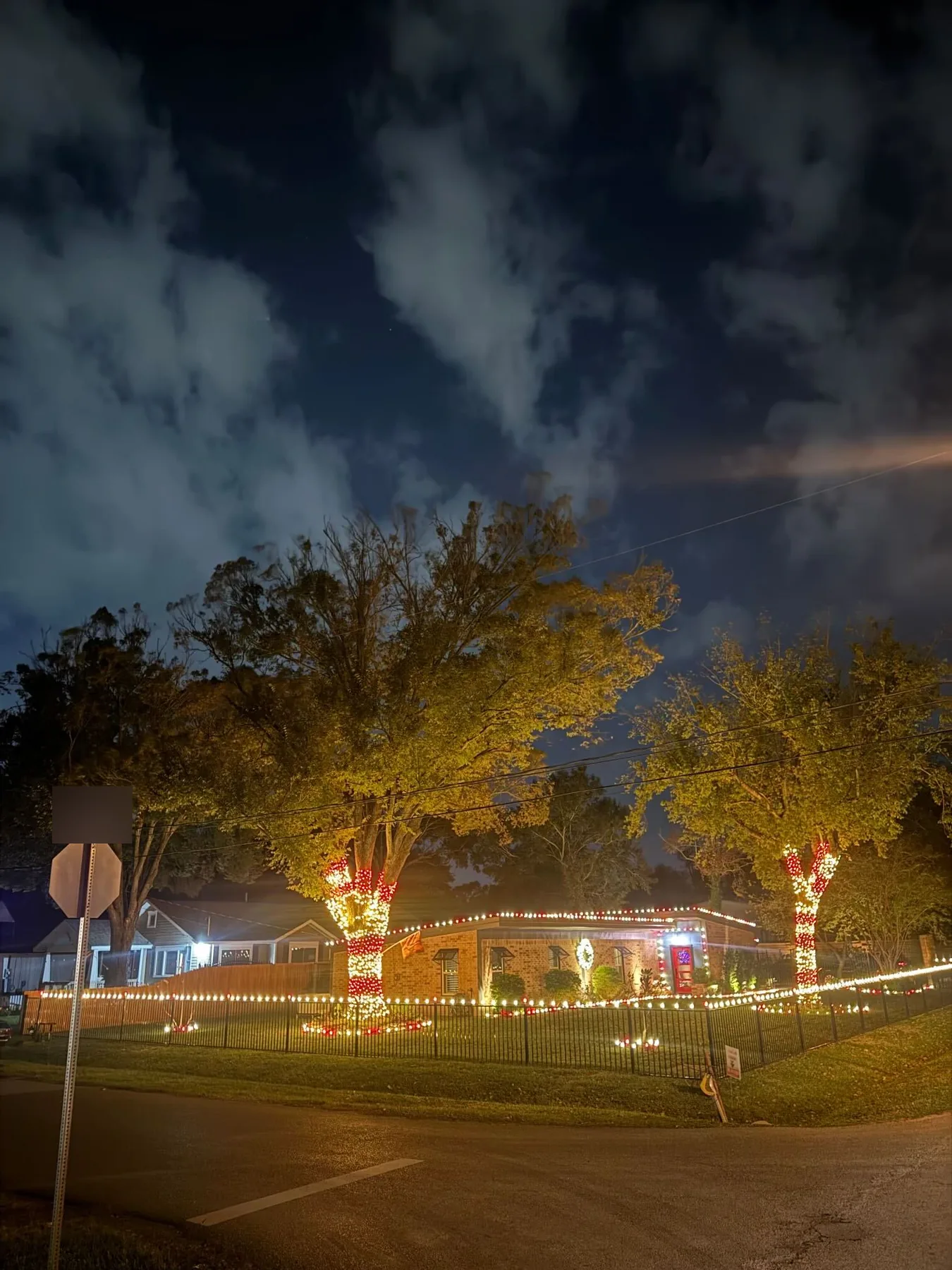
Why wildlife meets your lights
A holiday display puts wiring in places where animals already live: oak and pecan canopies, eaves, gutters, fences and the edges of the yard. Squirrels, rats, mice and birds all use those routes, and some of them chew. It is not malice, but a habit of animals that gnaw to keep their teeth worn down.
In most homes, the problem is rare. But in properties with mature trees and plenty of cover, which describes much of the Conroe and Woodlands area, it is a real possibility, and it helps to know the signs.
Signs of animal damage
The clearest sign is a clean break in the wire, often with the insulation stripped back or gnawed at the edges. The damage is usually in a single spot, where the animal sat or crossed, and the section beyond it goes dark. A strand that fails near a tree, an eave or a fence is more likely to be an animal than a weather problem.
Other signs include bits of insulation on the ground, droppings near the base of a tree wrap, nests or nesting material near the display, and a dark section that returns after repair. If you see any of these, mention them when you call.
- A clean break or gnawed insulation in one place
- Damage that sits near a tree, eave, fence or gutter
- Insulation fragments or droppings nearby
- Nesting material in or near the display
- A repair that fails again in the same spot
Squirrels
Squirrels are the usual suspects, since they travel along branches, fences and rooflines and are active in the daytime. They are drawn to tree wraps because the wires run along their routes. Damage tends to appear on trunks and low limbs, and on wiring that crosses between a tree and the house.
There is no foolproof way to prevent squirrel damage, but several things help. Keep the wiring close to surfaces rather than hanging in the open, avoid leaving slack where an animal can sit on it, and trim branches that bridge between the trees and the roof. A careful layout reduces the chances.
Birds, rodents and nesting
Birds are less likely to chew wire than to nest in the eaves or among the lights. A nest does not usually damage a display, but it can hold moisture and shift connections. Rodents may use the cover of the lights, and they can chew as well.
If you find a nest, leave it to the experts and wildlife rules. Some species are protected, and you should not disturb an active nest. Tell us where it is, and we will work around it and make sure the lights are secure.
What you can do
Prevention is mostly about habit. Keep food sources such as bird feeders and trash away from the display, trim branches that touch the roof or the lights and look over the display weekly. If you notice a pattern, such as repeated failures in the same tree, tell us early.
Avoid using home remedies such as sprays or deterrents on the wiring. Many are not designed for electrical equipment and can damage the insulation or create a hazard. If you want to try something, ask us first.
What we do
In-season maintenance is free, and service requests are answered within 24 hours, seven days a week. If an animal has damaged a section, we replace it. If the damage repeats, we look at why: the route, the slack, the trees and the position of the wire. We adjust the layout where we can.
At the end of the season we note which areas were affected and plan next year's installation accordingly. Because the set is stored and reinstalled, the lessons are built into the following year. See the maintenance and warranty hub for how to request service.
When to worry
Most animal damage is a nuisance, not a danger. But exposed wire is a hazard, so treat any visible damage seriously. Switch the affected section off, stay clear of exposed wire and do not touch it. Call us and we will make it safe.
For help working out whether a dark section is wildlife or something else, use our troubleshooting checklist.
How design reduces the risk
A careful design lowers the chances of animal damage without any gadgets. Wires that lie flat against a surface give an animal nothing to grab. Runs that avoid long, unsupported spans through branches are less attractive as pathways. Connections placed away from nests and runways are less likely to be disturbed.
This is part of why custom cutting helps. Each run is the right length, so there is no excess cord looped in a tree for an animal to sit on. The layout can also take account of what we know about your property, such as the tree that squirrels use as a highway to the roof.
If you know where animals travel on your property, tell us. That knowledge is more useful than anything we can see from the ground.
Repairs and prevention across seasons
Because we store and reinstall your set, we see it up close every year. Any section with signs of gnawing is repaired or replaced before it goes back up, so a weakness in one season does not carry into the next.
We also keep notes about each property. If a particular tree or eave has been a problem, we adjust where the wiring runs the following year. Over time, a display on a wooded lot becomes more resistant, because it has been tuned to the animals that live there.
That is another benefit of a program rather than a one-off installation, and it is the opposite of a box in the garage that is pulled out once a year and hung the same way every time.
A note on safety and wildlife
Never try to remove an animal from your display yourself. Squirrels and other wildlife can bite and scratch, and exposed wire may be live. If an animal is trapped in or tangled with the lights, call local animal services or a licensed wildlife professional, and switch the display off at the outlet.
Once the animal is safely away, call us and we will assess the damage and make the display safe. In-season maintenance is free, and service requests are answered within 24 hours, seven days a week.
Frequently asked follow-ups
Will the lights attract animals? Lights themselves are not known to, but the cover and routes a display shares with trees and eaves may bring animals along paths they already use. Does it matter which kind of lighting I have? Wiring is wiring, and any outdoor cord can be gnawed, which is why layout matters more than the type of bulb.
Can I put the lights away from the trees? Sometimes. If a tree is the problem, we can leave it out or choose a different treatment, such as a trunk wrap only, and add other elements elsewhere. Tell us what you would like and we will say what is practical.
What if the damage is on the house wiring rather than the lights? That is outside what we service. Call a licensed electrician, and switch off the outlet in the meantime.
Questions people ask
Sometimes. Squirrels and rodents gnaw wire, particularly near trees and eaves. It is not common, but it is a possible cause of a dark section.
In-season maintenance is free and service requests are answered within 24 hours, seven days a week. Tell us what you found and we will repair it.
We advise against it. Many products are not designed for electrical equipment and can damage insulation. Ask us first.
By the Holiday Lights Texas team, a family owned holiday lighting company based in Conroe, Texas. Published October 19, 2026, updated October 19, 2026. Every figure and policy referenced here is one the company publishes and honours on real properties. Where the company has not published a policy, this guide says so rather than guessing.
More in MaintenanceAll resources