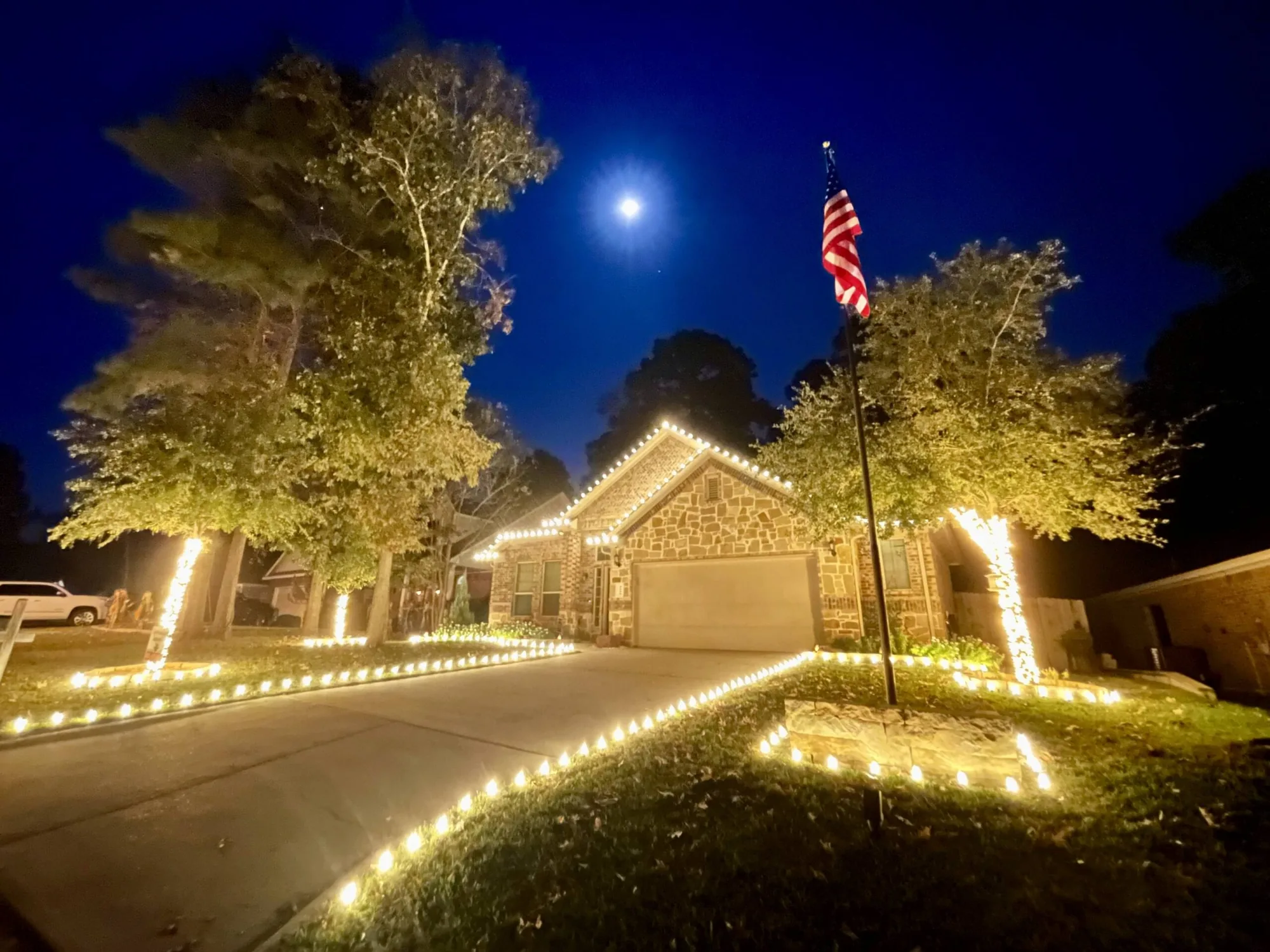
First, look at the pattern
The pattern of what is out tells you a lot. If the entire display is dark, the cause is almost always power: the outlet, the timer or a tripped GFCI. If one run is dark from a certain point to its end, a connection or a break is likely at that point. If random individual bulbs are out, a bulb or its socket is the cause.
Stand at the street and note exactly where the dark begins. Write it down or take a photo. That single observation often leads to the answer, and it is the most useful thing you can tell us if you call.
Whole display dark: check power
Start at the outlet. Is it live? A GFCI that has tripped is the most common culprit, especially after rain. Press the reset button once. Then check the timer: is it plugged in, set to the right time and not in the off position? If a breaker has tripped, the display may share a circuit with something else that drew a heavy load.
Our guide to GFCI outlets and timers walks through each step. If the outlet and timer are fine and the display is still dark, the fault is in the lights, and you should call us.
One section dark: look for the break
When one run is dark, the problem lies at or just before the point where it goes out. Common causes are a connection that has come apart, a plug that has pulled loose in the wind, a section disturbed by a branch or a storm, or a connector that has gotten wet. Look from the ground for anything hanging, separated or out of place.
If the dark section starts where two runs meet, the connection is the first suspect. If it starts at a corner, a clip may have come off and the strand may be under strain. Resist the urge to climb up and fix it. A roofline repair is exactly what we are here for.
Individual bulbs out
A single dark bulb in an otherwise lit run is usually a loose or failed bulb. LED lighting is designed to last a long time, but individual bulbs can fail or work loose in the socket. In many modern sets the rest of the run continues to work when one bulb is out.
A few dark bulbs scattered through a display are not a reason to panic, but they are worth fixing before they spread. Report them and we will replace them during an in-season visit. For how long LED sets typically last, see how long LED Christmas lights last.
Flickering and dimming
Lights that flicker or look dimmer than usual often point to a poor connection or moisture. Damp weather is a frequent cause, and it often clears when things dry out. If it persists on a dry night, there may be a failing connector or a voltage problem along a long run.
Do not ignore flicker that gets worse. Intermittent connections can overheat, and the safe course is to switch off the affected section and call for service.
After a storm or high wind
Texas weather can be hard on outdoor displays. After a storm, check the outlet first, since heavy rain commonly trips a GFCI. Then look for anything that has moved: a strand sagging between clips, a plug pulled out of its connector, a limb that has come down across a tree wrap.
If there is visible damage, stay clear of any strand that is hanging low, in standing water or touching metal. Switch the display off at the timer or outlet and call us. Our guide to what happens when a bulb goes out explains how a service visit works.
What is safe to check yourself
From the ground, with dry hands and dry feet, you can safely check the outlet, reset a GFCI, confirm the timer is on and set, and look for visible disconnections. You can note where the dark section starts and take photos. These steps solve a large share of problems.
Do not climb a ladder, touch a damaged cord, work in the rain or reach into a connection that is wet. Those steps are not worth the risk.
- Reset the GFCI once, with dry hands
- Check that the timer is plugged in, correct and on
- Note where the dark section starts
- Take a photo at night
- Switch the display off if you see damage
When to call, and what to say
If the checks do not fix it, call (936) 499-8984 or submit a service request on the maintenance and warranty page. Tell us where the dark begins, when it started, what the weather was like and what you have already tried. A photo helps.
In-season maintenance is free, and service requests are answered within 24 hours, seven days a week. That is the point of a maintained display: a dark section is our job to fix, not yours.
Preventing problems before they start
Most failures can be prevented by good installation and a little attention. Lights that are clipped evenly, with slack where they need it and connections protected from water, last longer than lights hung hurriedly. This is the single biggest reason professional installations are more reliable than most DIY ones.
You can help. Keep the timer and outlet dry, avoid hanging anything from the lights, trim vegetation that touches wraps and tell us if anything about the property changes. A quick look at the display from the street each week is enough to catch most problems early.
A seasonal checklist
A simple routine makes the season easier. Check the display on the first evening it is switched on. Check again after any storm. Look at it from the street once a week. If anything looks wrong, note it and report it, rather than waiting for it to get worse.
At the end of the season, mention anything that bothered you. A section that kept failing, a connection that always seemed damp or a tree that has grown into its wrap is easy to fix before storage and difficult to fix next autumn.
What a service visit looks like
When we come out, we start where you told us the dark begins. We check the connection at that point, trace the run in both directions and replace whatever has failed, whether that is a connector, a section or a single bulb. Most visits are quick, and you do not need to be home.
Afterwards we check the whole display, not just the repair, because problems sometimes come in pairs. If we find something that will fail soon, we fix it while we are there, so you are not calling us again next week.
A note on keeping a log
If a problem keeps returning, write down when it happens. Note the time of day, the weather and which section goes dark. Patterns such as every damp morning, every windy night or every time the porch light is switched on point straight at the cause. A few lines in your phone is enough, and it gives the service team a head start when they arrive.
Questions people ask
Usually a connection or a tripped outlet. If everything is out, check the GFCI and the timer. If one run is out, look for a disconnected plug or a break where the dark begins.
From the ground, yes, for simple checks such as resetting a GFCI and confirming the timer. Do not climb a ladder or handle damaged cords. Call us for roofline and tree repairs.
In-season maintenance is free, and service requests are answered within 24 hours, seven days a week.
By the Holiday Lights Texas team, a family owned holiday lighting company based in Conroe, Texas. Published October 19, 2026, updated October 19, 2026. Every figure and policy referenced here is one the company publishes and honours on real properties. Where the company has not published a policy, this guide says so rather than guessing.
More in MaintenanceAll resources