Why communities do this
A holiday light-up night turns a handful of well-decorated houses into something the whole neighborhood shares. People walk the streets, meet neighbors they have only waved to and children get a reason to stay out after dark. It builds the kind of goodwill that makes a community feel like one, and it costs little compared with the effect.
It also helps the lighting. When people know there is an event, they are more likely to take part, and the street looks better as a whole. A shared date gives everyone a deadline.
Two formats: a switch-on or a tour
A switch-on is a single evening when the community lights its entrance, monument or common areas in a short ceremony, often with cocoa, carols and a countdown. It is easy to organize, it centers on the lighting of shared spaces and it fits a short window.
A tour runs over several evenings. Houses opt in, a map or list is shared, and residents walk or drive the route. It needs more coordination but lasts longer, and it rewards individual effort. Many communities do both: a switch-on to open the season and a tour for the weeks that follow.
Picking dates
In 2026 Thanksgiving is Thursday, November 26 and Christmas Day is Friday, December 25. The weekend after Thanksgiving is the classic time for a switch-on, since most displays are up by then. A tour could run from that weekend until the week before Christmas.
Check the calendar for school events, religious holidays and other community commitments, and avoid clashes. Announce the dates early, as people need time to plan their own lighting.
Rules, permission and neighbors
Before you promote an event, check your governing documents and speak to the board or management company. Events on common areas may need approval, and any use of public streets may need permission from the relevant authority. Our HOA guide covers the basics.
Think about the neighbors who will not be taking part. Keep noise reasonable, provide clear parking and set start and finish times that respect the evening. A courteous event is more likely to be welcomed next year.
Safety and logistics
A lit street at night is also a street with extra foot traffic and slow-moving cars. Encourage walkers to use sidewalks, mark any crossing points and keep the route well lit. If the event is on common ground, think about first aid, accessibility and a clear way out.
Electrical safety matters too. Outdoor outlets should be GFCI protected, cords should be kept off walkways and equipment should be rated for outdoor use. See our GFCI guide.
Lighting the shared spaces
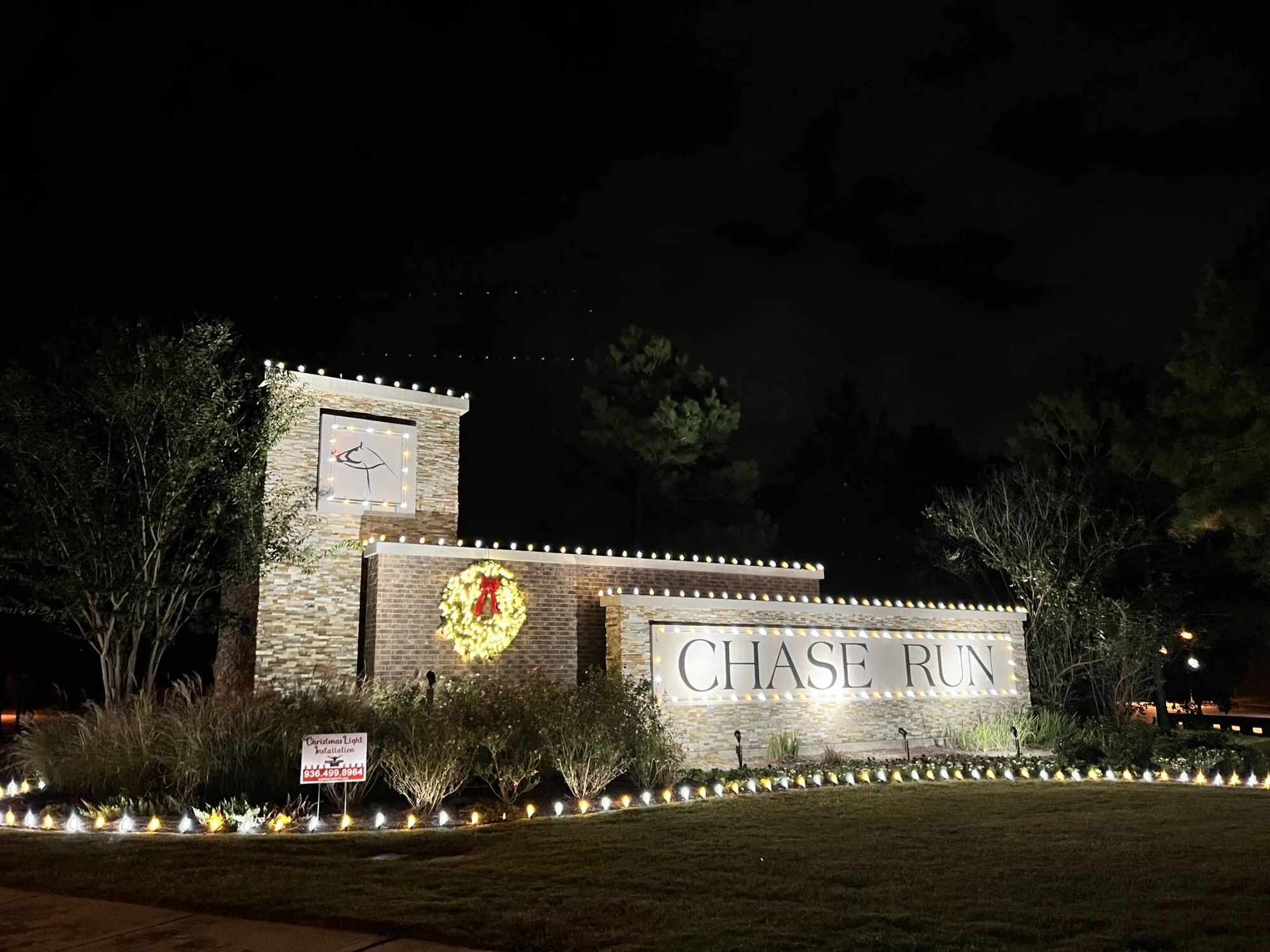
The entrance monument, the clubhouse, the pool house and the common-area trees are the heart of a community display. Lighting them professionally gives the event a focal point and sets a standard that residents can match. We work with communities as well as homeowners, and our HOA and community holiday lighting page explains how.
Our photo of a neighborhood entrance monument shows what a restrained, well-lit entry can look like. Properties like these are scoped on site, with the quote based on measured footage and the same published rates we use elsewhere.
Encouraging residents to take part
A friendly invitation works better than a rule. Share simple guidance on timing and courtesy, offer a map and consider a light-hearted recognition, such as a street award voted on by neighbors. Avoid anything that pressures people who do not wish to take part.
For residents who want a polished display without the work, a professional installation is a good answer. Several households on a street booking together can also simplify the scheduling. Call (936) 499-8984 to discuss.
A simple checklist
Use this list as a starting point. Adapt it to your community and your governing documents.
Planning a few weeks ahead is enough for most events, and a simple, well-run evening is better remembered than an ambitious, chaotic one.
- Confirm permission with the board or management company
- Choose the date and format, and announce it early
- Plan for parking, accessibility and first aid
- Check outdoor power and use GFCI protection
- Light the entrance and common areas
- Share a map or list for a tour
- Thank volunteers and neighbors afterwards
Making the evening feel special
A switch-on does not need to be elaborate to be memorable. A short countdown, a few words from a neighbor or board member, hot chocolate and a place for children to stand near the lights is enough. The moment when the entrance comes on at once is the heart of the event.
Consider having a photographer, even an amateur one, capture the moment. Photos from the first year become part of the community's story, and they make good material for next year's invitation.
If you can arrange it, have the display ready the day before and test it, with the timer set to come on at the chosen minute. A switch-on that fails in front of a crowd is a memory of the wrong kind.
Running a tour well
A tour works best with a simple route. A map or list of participating addresses, a suggested direction and a request to drive slowly and respect driveways keeps things orderly. A start and end time for each evening avoids late-night traffic.
Consider accessibility for those who cannot walk far. A route that can be driven, or a shorter walking loop, welcomes more people. Provide a contact for questions and keep the information in one place, such as the community newsletter or a shared page.
At the end of the season, ask residents what worked. A short note of thanks and a few lessons for next year turn a one-off into a tradition.
Budgets and who pays
Community lighting can be funded in several ways: the association budget, a voluntary contribution from residents or a mix. Pricing is simple to explain, since it follows measured footage at published rates: $6, $8 or $10 per foot of roofline by height, $5 per foot of ground lighting and $37 to $42 per tree strand.
For an entrance monument, a gate and a few common-area trees, a clear quote with the footage and what is included lets a board decide with confidence. Removal and storage are part of the price, which keeps the annual cost predictable.
To start the conversation, call (936) 499-8984 or use the contact page.
What a professional adds to a community event
A professional installer can take the technical side off the volunteers. We measure, design, cut and install the shared displays, set the timers and maintain them through the season, then remove and store everything afterwards. Volunteers can focus on the people.
We can also help with timing. If the switch-on is on the Saturday after Thanksgiving, we can schedule the install a few days before and set the timers to come on at the chosen minute. Everything is tested ahead of time.
Ask for a site visit before you set the budget. It is the best way to get a firm number, and there is no obligation.
After the event
Take time to thank the people who made it happen, and share a few photos with the neighborhood. Note what worked and what did not while it is fresh, and decide on a date for next year before the lights come down. A tradition grows when people can plan for it.
If you would like help lighting your entrance or common areas for next season, start the conversation in the spring or summer, when the calendar is open and a board can plan its budget calmly.
Questions people ask
The weekend after Thanksgiving is the classic date. In 2026 Thanksgiving is November 26, so that weekend falls on November 28 and 29.
Yes. We work with communities and HOAs, and properties like these are scoped on site with quotes based on measured footage.
Probably. Check your governing documents and speak with the board or management company, and check whether any public street use needs approval.
By the Holiday Lights Texas team, a family owned holiday lighting company based in Conroe, Texas. Published October 19, 2026, updated October 19, 2026. Every figure and policy referenced here is one the company publishes and honours on real properties. Where the company has not published a policy, this guide says so rather than guessing.
More in HOA & NeighborhoodAll resources